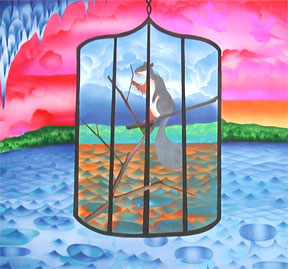
I'm going to fall over dead. Tony Fitzpatrick is a total genius printmaker. Look at this work. Holy crap.
Friday, January 11, 2008
I am not worthy!
I got a random compliment by email this morning from Tony Fitzpatrick! He likes my work! He saw it on the Gallery Joe website.
I'm going to fall over dead. Tony Fitzpatrick is a total genius printmaker. Look at this work. Holy crap.

I'm going to fall over dead. Tony Fitzpatrick is a total genius printmaker. Look at this work. Holy crap.
Wednesday, December 05, 2007
The Work of Art in the Age of My Cell Phone
Sunday's New York Times magazine had an interesting article about museums making digital versions of masterpieces. The article turned on the idea of the Boston Museum of Fine Arts' new fund raising idea: they sell little images of their artworks as cell phone wallpapers. I thought it sounded pretty cheesy when I read about it, but then I went to the site and saw this image.

Oni at a Barbershop from the series The Popularization of Civilization
Kitazawa Rakuten
Late Meiji era, 1905
Color lithograph; ink on card stock
Overall: 8.8 x 13.8 cm (3 7/16 x 5 7/16 in.)
Museum of Fine Arts, Boston
Leonard A. Lauder Collection of Japanese Postcards
2002.987
I want it. And it's not the only one I want, to tell the truth- there are lots of nice ones, and I want them all. It turns out I have no problem with having a tiny digitized masterpiece on my cellphone.
I don't feel as sanguine about the other example of masterpiece digitization cited in the article. The image in question, The Last Supper, is one that I've never seen outside of a reproduction in any case, but this latest reproduction has gone too far. There is a website that shows DaVinci's Last Supper in amazing fly-eye-view high resolution: one can zoom in to an astounding degree and see individual paint flakes. It's fun, but it definitely offends the original. But that's because of the music. Check it out.
Rakuten Kitazawa, who made the image that I need for my cell phone, is called the father of anime. He was an early cartoonist in Japan who, among other things, worked for an American comic magazine called "Box of Curious." You can read more about him here.

Oni at a Barbershop from the series The Popularization of Civilization
Kitazawa Rakuten
Late Meiji era, 1905
Color lithograph; ink on card stock
Overall: 8.8 x 13.8 cm (3 7/16 x 5 7/16 in.)
Museum of Fine Arts, Boston
Leonard A. Lauder Collection of Japanese Postcards
2002.987
I want it. And it's not the only one I want, to tell the truth- there are lots of nice ones, and I want them all. It turns out I have no problem with having a tiny digitized masterpiece on my cellphone.
I don't feel as sanguine about the other example of masterpiece digitization cited in the article. The image in question, The Last Supper, is one that I've never seen outside of a reproduction in any case, but this latest reproduction has gone too far. There is a website that shows DaVinci's Last Supper in amazing fly-eye-view high resolution: one can zoom in to an astounding degree and see individual paint flakes. It's fun, but it definitely offends the original. But that's because of the music. Check it out.
Rakuten Kitazawa, who made the image that I need for my cell phone, is called the father of anime. He was an early cartoonist in Japan who, among other things, worked for an American comic magazine called "Box of Curious." You can read more about him here.
Tuesday, November 13, 2007
Suspense
I recently posted a new drawing, Suspense, on my website. It's going to Aqua Art Miami with Gallery Joe this December.

There are details on the site that show the way the images play with the idea of narrative suspense, but it's better if you can see the piece in person. There is a plot that flows through the large S that involves insects, birds, childbirth, water, falling objects and people I know.


These little arrows at the end of the S say "Narrative", "Rhythm" and "Symmetry."
There are details on the site that show the way the images play with the idea of narrative suspense, but it's better if you can see the piece in person. There is a plot that flows through the large S that involves insects, birds, childbirth, water, falling objects and people I know.
These little arrows at the end of the S say "Narrative", "Rhythm" and "Symmetry."
Wednesday, October 10, 2007
Mr. Fruit Face
The New York Times today has a lovely slideshow of Giuseppe Arcimboldo's work, which is on exhibit at the Luxembourg Museum in Paris.


From the article:
"Mr. Fruit Face, as a friend of mine disdainfully calls him, has always been a guaranteed hit with the Transformer-age crowd. But his art is more serious and self-important than that. You can imagine him to have been the sort of initially jocular, learned dinner party companion whose arrogance makes itself known by the salad course. That he inspired thousands of appalling 20th-century Surrealists, apparently shocked at the genius of conceiving a gherkin to replace a nose, or a rose a cheek, isn’t his fault."
From the article:
"Mr. Fruit Face, as a friend of mine disdainfully calls him, has always been a guaranteed hit with the Transformer-age crowd. But his art is more serious and self-important than that. You can imagine him to have been the sort of initially jocular, learned dinner party companion whose arrogance makes itself known by the salad course. That he inspired thousands of appalling 20th-century Surrealists, apparently shocked at the genius of conceiving a gherkin to replace a nose, or a rose a cheek, isn’t his fault."
Subscribe to:
Posts (Atom)